

Kokumin Kyosai co-op head office
Kokumin Kyosai co-op stands for the National Federation of Workers and Consumers Kyosai Cooperatives. Based on the cooperative principle, Kokumin Kyosai co-op provides insurance and mutual help for its members, under the supervision of the Ministry of Health, Labor and Welfare and the Consumers' Livelihood Co-operative Society Law. Kokumin Kyosai co-op is a not-for-profit organization, owned, managed and utilized by members who wish to protect themselves financially and improve their living standards. Founded on the "One for All and All for One" ideal of cooperatives, Kokumin Kyosai
co-op is organized on the basis of person-to-person cooperation.
New start as Kokumin Kyosai co-op
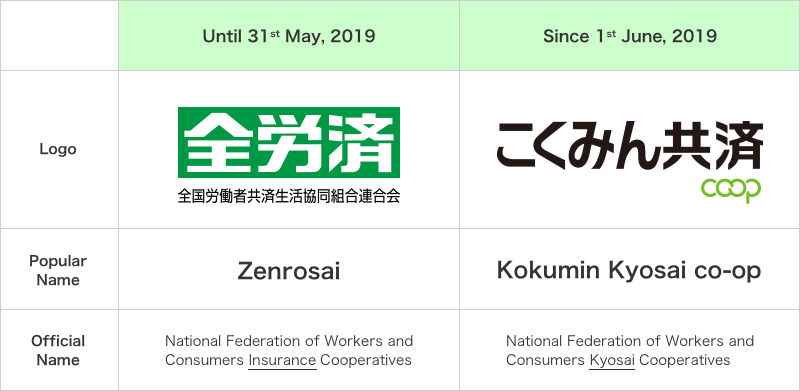
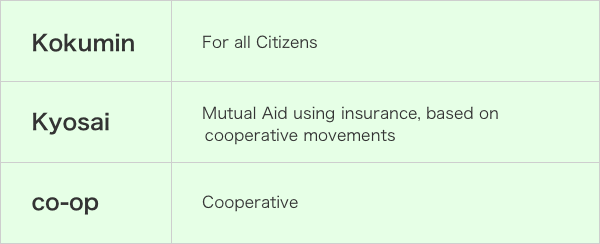
Zenrosai has decided to rebrand itself as “Kokumin Kyosai co-op” from June 2019. The new brand name is derived from our most popular product, short term life insurance “Kokumin Kyosai”, which is expected to raise public awareness of us. Additionally, it helps to clearly signify that our organization is a cooperative providing “Kokumin” or All citizens with “Kyosai” or Cooperative Insurance.
Also, we have changed our official English name to “National Federation of Workers and Consumers Kyosai Cooperatives” from “National Federation of Workers and Consumers Insurance Cooperatives”. There is no precise translation for the Japanese word Kyosai into English. "Kyosai" can be divided into two parts: Kyo means "mutual" and Sai means "to help". By directly incorporating the word "Kyosai" into our name, we are emphasizing the fact that we are a cooperative and provide mutual aid using insurance.
In order to become a more friendly and approachable organization, with the new name, Kokumin Kyosai co-op, we will further strive to expand the scope of helping each other through our cooperative insurance, improve the safety network for members and endeavor to achieve our mission, “Towards a Safe and Affluent Society with Mutual Help”.
Profile of Kokumin Kyosai co-op
| Name |
Kokumin Kyosai co-op (National Federation of Workers and Consumers Kyosai Cooperatives) |
|---|---|
| Head office |
Address: 2-12-10 Yoyogi, Shibuya-ku, Tokyo 151-8571 Japan TEL: +81 (3) 3299 0161 FAX: +81 (3) 5371 2685 |
| Web site | https://www.zenrosai.coop/english/ |
| President | Mr. Shuichi Uchikoshi |
| Established | 1957 |
| Structure | Cooperative |
| Full-time employees | 3,583 (As of May 31, 2023) |
| Premium income |
540.9 JPY billion :3.86 USD billion (Fiscal year ended May 31, 2023) |
| Total assets |
4,029 JPY billion : 28.82 USD billion (Fiscal year ended May 31, 2023) |
| Insurance offered |
Non-life: Fire, Natural Disaster, Automobile, Traffic Accident Life: Group life, Individual life, Annuity, Medical |
Annual Report
Back Number
Global Affiliation
The International Co-operative Alliance (ICA) is an independent, non-governmental organization that unites, represents and serves co-operatives worldwide. It exists to provide an effective and efficient global voice and forum for knowledge, expertise and co-ordinated action for and about co-operatives.
ICA members are international and national co-operative organizations from all sectors of the economy including agriculture, banking, consumer, fisheries, health, housing, industry, insurance and tourism. Currently, the ICA has member organizations from almost 100 countries, representing approximately 1 billion individuals worldwide. Around 100 million people work for a co-op globally.

ICMIF (International Cooperative and Mutual Insurance Federation) is a long established and unique global organization representing cooperative and mutual insurers from around the world. The important and common bond uniting ICMIF members is that they place the interest of policyholders/members before those of shareholders, working hard to ensure that they offer the best possible range of affordable products for their customers. ICMIF currently has more than 290 members from over 70 countries with approximately one-third of the membership in Europe, a further third in the Americas and the remainder representing Asia and Oceania, Africa and the Middle East.

The Asia and Oceania Association (AOA) of the International Cooperative and Mutual Insurance Federation (ICMIF) was established in 1984 to promote cooperative and mutual insurance activities, mutual friendship and exchange of information among ICMIF members in the Asia and Oceania region.

Dotcoop is a top-level Internet domain and exclusively to cooperatives around the world.
The global registry for the .coop is DotCooperation LLC-or, dotCoop. It is a wholly owned subsidiary of the National Cooperative Business Association with its own independent board of cooperative and credit union representatives from around the world.
ICA Statement on the Co-operative Identity
The Statement on Co-operative Identity was adopted at the 1995 General Assembly of the International Co-operative Alliance (ICA), held in Manchester on the occasion of the Alliance's Centenary. The Statement was the product of a lengthy process of consultation involving thousands of co-operatives around the world.
- ICA Statement on the Co-operative Identity
Definition
A co-operative is an autonomous association of persons united voluntarily to meet their common economic, social, and cultural needs and aspirations through a jointly-owned and democratically-controlled enterprise.
Values
Co-operatives are based on the values of self-help, self-responsibility, democracy, equality, equity and solidarity. In the tradition of their founders, co-operative members believe in the ethical values of honesty, openness, social responsibility and caring for others.
1st Principle: Voluntary and Open Membership organizations
Co-operatives are voluntary organizations, open to all persons able to use their services and willing to accept the responsibilities of membership, without gender, social, racial, political or religious discrimination.
2nd Principle: Democratic Member Control
Co-operatives are democratic organizations controlled by their members, who actively participate in setting their policies and making decisions. Men and women serving as elected representatives are accountable to the membership. In primary co- operatives members have equal voting rights (one member, one vote) and co-operatives at other levels are also organized in a democratic manner.
3rd Principle: Member Economic Participation
Members contribute equitably to, and democratically control, the capital of their co-operative. At least part of that capital is usually the common property of the co-operative. Members usually receive limited compensation, if any, on capital subscribed as a condition of membership. Members allocate surpluses for any or all of the following purposes: developing their co-operative, possibly by setting up reserves, part of which at least would be indivisible; benefiting members in proportion to their transactions with the co-operative; and supporting other activities approved by the membership.
4th Principle: Autonomy and Independence
Co-operatives are autonomous, self-help organizations controlled by their members. If they enter to agreements with other organizations, including governments, or raise capital from external sources, they do so on terms that ensure democratic control by their members and maintain their co-operative autonomy.
5th Principle: Education, Training and Information
Co-operatives provide education and training for their members, elected representatives, managers, and employees so they can contribute effectively to the development of their co-operatives. They inform the general public - particularly young people and opinion leaders - about the nature and benefits of co-operation.
6th Principle: Co-operation among Co-operatives
Co-operatives serve their members most effectively and strengthen the co-operative movement by working together through local, national, regional and international structures.
7th Principle: Concern for Community
Co-operatives work for the sustainable development of their communities through policies approved by their members.